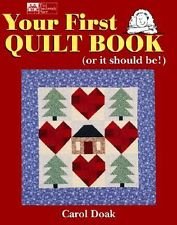
Your First Quilt Book (or it should be!) by Carol Doak (paperback)
If image is missing, and you need one, contact us at 423-715-2908 phone or text or info@hyderhangout.com
Intended for beginners, this volume offers an introduction to the tools, supplies, and techniques used in quilting, featuring eight small projects which utilize hand- or machine-stitching skills
About the Book
If you haven't got a clue about quilting, then this is the book for you! Written for beginning quiltmakers (and those who want to brush up on the basics), Your First Quilt Book introduces all the tools, supplies, and techniques you need to create simple patchwork quilts.
- Eight small projects are provided to help you practice your new hand- or machine-stitching skills
- Step-by-step illustrations, a friendly, conversational style, and a generous dose of humor keep the learning easy and fun
- Treat yourself to an enjoyable, anxiety-free first quilting experience and lay a solid foundation for your quiltmaking with this resource that you'll turn to again and again
Additional Information
From The Virtual Quilt (www.tvq.com)This wasn't my first quilt book. That (dubious) honor goes to Start Quilting, by Alex Anderson, which is a fine book with fun and simple projects. Since then I have read a few others, and I've picked up a few tricks through observation combined with trial and error. However, almost everything I've learned so far seems to be included in Your First Quilt Book (or it should be!). So I guess it should have been.
The very first thing in the book is a diagram and glossary of common terms, to enable the tourist and the new immigrant to pick up the language of quilt-land. I admit to not knowing before this book exactly what "quilt-as-you-go" meant (see page 12).
Next, the reader is introduced to fabrics. This section explores the right and wrong ways of juxtaposing fabrics of various color value, contrast, and type and size of prints. This is the only chapter other than the gallery to feature color pictures, and she's not miserly about it. I count 20 color photos in 7 pages, plus assorted gray scale diagrams, illustrating the effects of different choices (example: "the green in the first group (top) is too intense for the colors in the other fabrics. The green in the second group (bottom) works better because it is similar in intensity.") or defining textures (calicos, mini-prints, airy, dot, geometric, and so on). And, Carol Doak even deals with what to do if you run out of one of the fabrics in the middle of a project.
After fabrics, naturally, comes an introduction to tools. This is a short but informative section. I tend to think that for a beginning quilt book, the list of recommended tools is a bit too comprehensive. I certainly don't own everything on this list, yet I've managed to produce 2 full size quilts and a handful of miniatures. The list could also use some prioritizing - it's not alphabetical, or, in my opinion, in order of importance. First come graph paper and colored pencils, while items such as scissors, seam ripper, rotary cutter, cutting mat and rotary rulers come at the end - after "miscellaneous."
Once you know the language, the fabric, and the tools, you're ready to go. First, though, there's the chapter on patchwork block designs, which also tells how to draw any block any size without unwieldy math, and the chapter on patchwork technique, which in the beginning is as much a discussion of philosophy as anything else. Definitely take the time to take the "preference test," on the question of hand versus machine piecing. For the record, I am a machine piecer - but now I know why.
Your First Quilt Book (or it should be!) provides 8 different projects, all of which are simple enough for a beginner yet interesting enough to be worth doing. The projects are chosen to include a variety of techniques. Some use templates, some use sequences of cuts (cut a 3-1/2" square, then cut it in half diagonally to make 2 triangles). Techniques such as laying out on point, strip piecing, sashing, and corner squares are highlighted. There's a gallery with a color photo of each project, and detailed step by step instructions. One especially nice thing is that in the margin of each page in the projects sections are two drawings of what your stitch should look like, whether it is done by hand or by machine.
This book also includes a good discussion of whether to hand quilt, machine quilt, or tie, and how to proceed in each case. Finally, binding is explained, and the book closes with a collection of templates, a collection of quilting designs, and a list of suggested further reading.
Bottom line: you probably should buy this book. If you are about to start your first quilt, this will get you through it. If you've already done your first 1, 2, or 20 quilts, but still have to look through your entire quilting library to figure out the measurements for setting triangles or the proper way to sew along the bias, this will provide some welcome consolidation. This book can only cover so much, but it does a very good job as a beginner book.